| Availability: | |
|---|---|
| Quantity: | |
Product Introduction
Common specifications range in size from 85 mm to 280 mm. High-Pressure Bit Types (Classified by Face Profile): Flat-Face Bits: Best suited for drilling in hard to extremely hard rock formations, offering exceptional resistance to erosion (steel body wear). Convex-Face Bits: Specifically designed to achieve high penetration rates in soft to medium-hard rock formations. Concave-Center Bits: Ideal for achieving high penetration rates in soft to medium-hard, highly fractured rock formations, while simultaneously providing excellent borehole deviation control.
Key Features and Advantages: Superior Performance: Engineered specifically for high-pressure systems, designed to maximize rock-breaking force and thereby achieve faster penetration rates. Robust Durability: These bits typically feature carbide inserts (available in convex, flat-face, or concave-center designs) and are manufactured using forging processes, ensuring excellent and long-lasting performance even in highly abrasive operating conditions. Efficient Hole Cleaning: High air pressure facilitates superior removal of cuttings from the bottom of the hole, effectively preventing the re-cutting of rock chips and thereby extending the service life of the drill bit. Wide Range of Applications: Suitable for various drilling environments, including geotechnical exploration, quarrying operations, and mining extraction.
Operating Pressure: Typically operates at pressures significantly exceeding 150 PSI to achieve optimal efficiency; in certain specialized applications, dedicated bits are utilized to accommodate ultra-high-pressure conditions exceeding 24 bar. Advantages Over Low-Pressure Solutions: When utilizing a properly matched high-pressure DTH bit and hammer system, the time required for drilling can be significantly reduced (for example, the time required to drill 100 meters at a pressure of 24 bar is approximately half the time required at a pressure of 12 bar).
Product Advantage
In drilling operations—particularly when utilizing Down-the-Hole (DTH) hammers—high air pressure can significantly boost the drilling speed (or penetration rate). This is because high air pressure enables the piston to generate more powerful and rapid impact forces, thereby fracturing hard rock formations more effectively.
Furthermore, high air pressure improves hole-bottom cleaning efficiency by enhancing the rate at which rock cuttings are evacuated; this, in turn, facilitates faster and more stable drilling performance. The primary advantages of high-pressure (high-PSI) drilling include: Faster Penetration Rates: The foremost benefit is a significant increase in operational efficiency within hard rock formations, as higher air pressure translates to greater impact energy delivered to the drill bit. Superior Hole-Bottom Cleaning: Elevated air pressure facilitates the more efficient transport of rock cuttings to the surface, thereby preventing the drill bit from re-cutting previously fractured material. Exceptional Performance in Deep-Hole Operations: Increasing air pressure ensures that the airflow possesses sufficient power to drive the DTH hammer efficiently, even in deep-well applications where lower air pressures often struggle to provide adequate operational force.
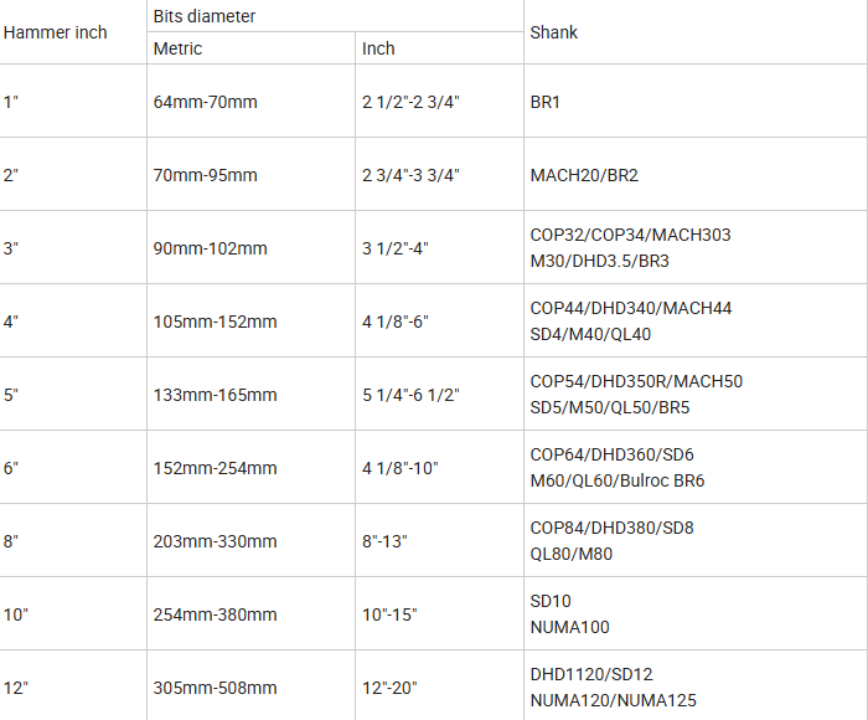
Technical Parameters

FAQ
Is there a minimum order quantity (MOQ)?
Yes, the minimum is 5 units.
Do you accept pre-order testing?
Yes; however, the customer is responsible for the cost of samples and shipping fees. The minimum order for samples is 5 units.
Do you accept customization?
Yes; this requires either technical drawings or physical samples.
Can colors and logos be customized?
Yes. If no specific requirements are provided, the standard color is black. Laser engraving for logos is available for orders of 10 units or more.
What is the typical lead time?
We maintain ample stock, so the standard lead time is typically 2 days. In the event that items are out of stock, batch production requires 10–15 days.
Do you hold any relevant quality certifications?
Yes, we hold both BV and CE certifications.
What is the the different between low and high air pressure?
Compared to operating under low-pressure, low-efficiency conditions, the powerful impact force generated by a high-air-pressure system can effectively reduce the wear and tear on the tool itself.